Tuesday, May 5, 2015

Daniel Boone (1734-1820)

I’ve been reading a very interesting book about Daniel Boone called Boone: A Biography, by Robert Morgan (Algonquin Books of Chapel Hill, 2007). As my niece Nina McClellan Atchley discovered years ago, Daniel Boone was a relative. He was actually my fifth great-grand uncle; his sister Hannah Boone Stewart Pennington was my fifth great-grandmother.

I confess that I knew little of Daniel Boone beyond the Disney version of his story. The more I read about him, the more I identify with certain traits he held. In the book, he’s described as both a loner and gregarious. He was terrible with money and constantly in debt. It wasn’t that he was a deadbeat—he actually put a lot of effort into his money-making adventures; it’s just that he risked a lot on his vision of his future, often finding that things didn’t quite work out the way he’d planned. That never seemed to stop him from seeking new adventures, new frontiers to explore. He was restless, finding it almost impossible to stay home and settle into the daily life of an 18th century American farmer. He loved his wife and children, and yet he would take off for months, even years, at a time, while he searched for that patch of Eden that would satisfy him.

It was this passage from Boone that really resonated with me. Morgan quotes Lord Dunmore, the British-appointed governor of Colonia Virginia, as saying, “Americans…do and will remove as their avidity and restlessness incite them. They acquire no attachment to Place: But wandering about seems engrafted in their Nature; and it is a weakness incident to it, that they should forever imagine lands Further off, are Still better than those upon which they are already Settled.” Guilty as charged.

Daniel Boone kept moving west until he was able to settle with his family in what he must have seen as his ultimate paradise: the lush and fertile land of Kentucky. He had made a few trips to Kentucky before he actually settled there. I can only imagine how much his wife, Rebecca, must have rolled her eyes every time he came back from one of his excursions filled with tales of the promised land that lay just beyond the mountains. I’m sure it didn’t help that he usually came back empty-handed and penniless, having lost whatever furs, hides, ginseng, and other treasures he had acquired on his trip to Cherokee, Shawnee, Delaware, and other indigenous groups not so keen on having white settlers move into yet another expanse of the land they called home.

Boone had a relationship of mutual respect with most of the Native Americans he encountered during his lifetime. Boone embraced their understanding of and reverence for the natural world, adopting many of their techniques for hunting and moving through difficult terrain. At times he was captured by Indians who wished to relieve him of his—in their minds illegally gotten—gains, the exchange between captors and captive was by all accounts relatively polite and even collegial. Even in his grief when his son James was killed by a group of Delawares, Shawnees, and Cherokees, angry at the encroachment into their hunting territory, Daniel seemed to understand that this was the price of the fight for land.

Daniel Boone was known for his wit and storytelling. Despite his love of solitude when he disappeared into the wilderness, Boone loved large gatherings of friends and families, where he would entertain his audience with jokes and hair-raising tales of some of his most dangerous adventures. He also loved to sing. One of my favorite anecdotes about Daniel Boone has to do with some men who hear a strange sound coming from a place deep in the wilderness. They follow the sound to find Boone, sitting by his campfire, all by himself, singing at the top of his lungs. My kind of man.


I know it might seem silly to some to look to distant relatives for the origins of one’s own character traits, but I can’t help but think that there’s a certain truth in such connections. Daniel Boone is recalled and admired for his love of adventure, his sense of honesty and his sense of humor, his loyalty, his philosophical approach to the ups and downs of life, and his reverence for nature. These are qualities that have been highly revered and encouraged in the families that are part of my lineage and tradition. There is truth in that.

Painting of Daniel Boone by Alonzo Chappel

Monday, February 9, 2015

Who Are These People?


Given the hundreds—make that thousands—of photos that I've inherited, a few are unidentified. This is one of my favorites. I'm pretty certain these people are relations, but I'm not even sure which family branch they belong to. One way or another, my brother Johnny wasn't the first cellist in the family.

Margaret Lucy Long Osborne (1856-1930)

Maggie, Newly Widowed, in 1885
My beautiful great-grandmother Margaret Lucy Long Osborne, AKA Maggie, was a mere 29 years old when she lost her husband, Abner McDowell Osborne; hence the widow's weeds in this picture of her. Abner, known as Mac, was a conductor for the Northern Pacific, and he died in 1885 in Missoula, Montana, trying to stop a runaway train. Maggie was left to raise four little girls on her own and did a bang-up job by all accounts.

Little Alma Osborne
Mac had been married before he met Maggie, but his first wife, Frances, died in Laramie, Wyoming, in 1876. She probably died from some illness, but the newspaper account doesn't give the cause of death. Frances left behind a thirteen-month-old daughter named Alma, above, shown wearing mourning clothes, poor little thing. Such tragedies were common in those days, but I can't imagine that the grief of losing a loved one was any easier.

Clockwise from left: Julia, Pearl, Alma,
Georgia Osborne, circa 1900


The Osborne women, mother and daughters, were very close. After Mac died, Maggie and the girls moved to Colorado to be near her sister, Julia Long Roberts. Eventually (mid 1890s?), Maggie and the girls moved to Los Angeles, along with Maggie's mother, Margaret Matilda Armstrong Long.
The girls, Julia (my maternal grandmother), Pearl, Alma, and Georgia, all lived very close to each other as adults and raised their families together. They had huge family gatherings, and Grandma Maggie was the beloved center of it all.


1919 Osborne Family Gathering
Maggie Behind My Mother's Gigantic Bow


Maggie circa 1920s


Although Maggie's life could be painted as tragic—she lost her father when she was six, her husband when she was twenty-nine, and one of her brothers ten years after that—she found the strength to carry on, on her own, raising her daughters to be strong, loving women who saw the joy in life. I know that she was a woman of deep faith, and that must have sustained her through the tragedies, but there was something special in her spirit that made her look at the blessings in her life rather than dwell on the losses. I suspect that Maggie's influence was part of the reason my mother was so unflaggingly upbeat in her own life. Maggie died at 74 in 1930, having left behind a legacy of love and faith. How I wish I had known her!

John Arthur McClellan

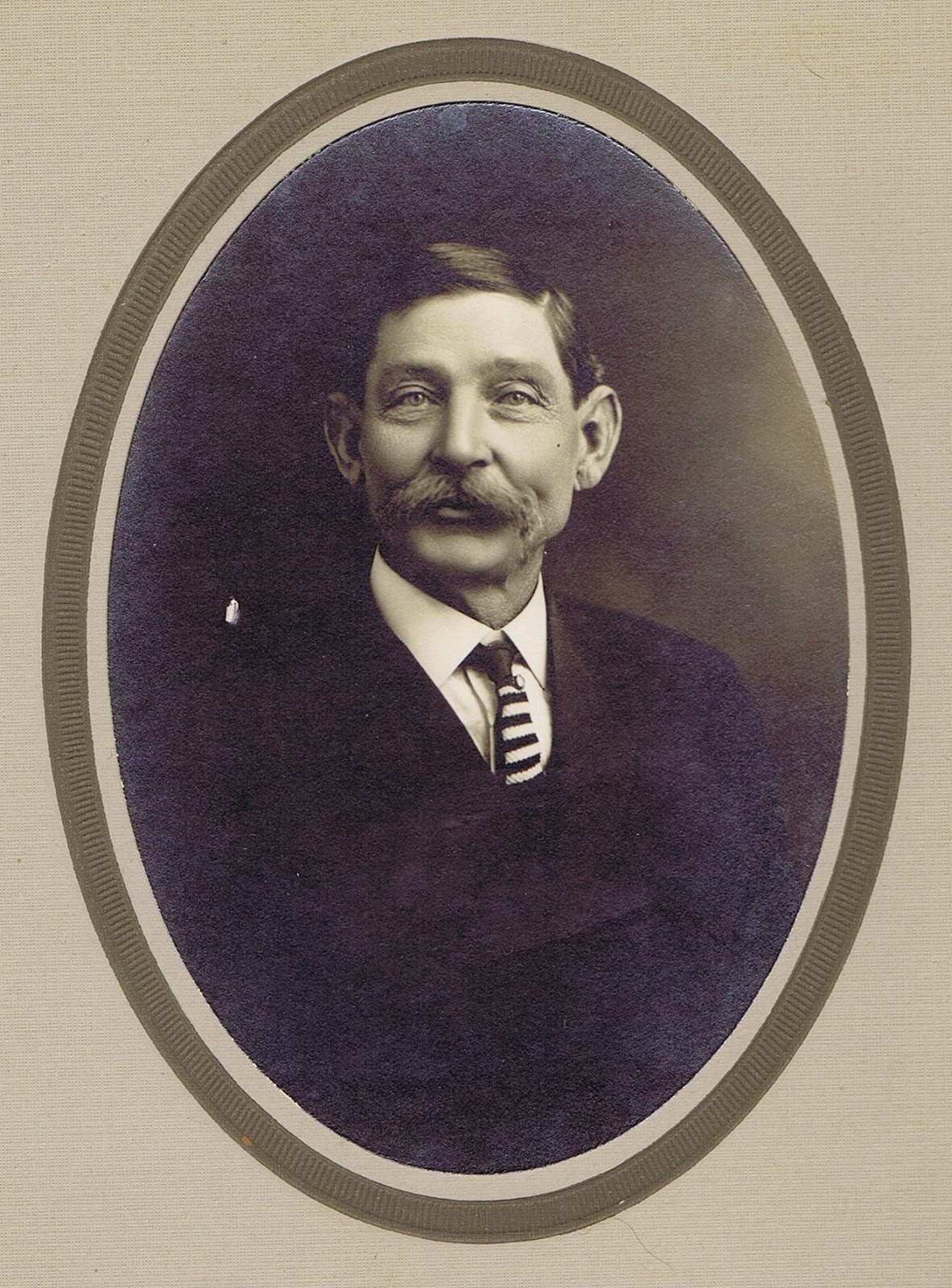
My paternal great-grandfather, John Arthur McClellan, was born in La Grange, Texas, in 1852. The son of a newspaper man, John Arthur wasn't exactly career driven. He was a farm hand, had his own farm for a while, and then picked up the tinner's trade. After his wife, Margaret Young McClellan, died in 1908, he spent the rest of his years living with his children in Atlanta, GA; then Waco, TX; and finally La Verne, CA, where he died in 1935. He drove his daughter-in-law, my Grandma Mac, crazy when he lived with them; she came from hardworking German stock, and I think she just didn't get him. His daughter-in-law, my Grandma Pearl, adored him though, judging from the tone of her letters to him. He looks pretty affable in the pictures I have of him. So he didn't set the world on fire. I'll bet he could tell a good story.

Joseph Polk Crozier


From early 1900s, most likely: My maternal grandfather, Joseph Polk Crozier. Joe grew up on a small farm in Arkansas. He moved to Los Angeles to seek his fortune around the time this picture was taken. He landed a good job with Railway Express, sort of an early version of Fed Ex, married Julia Osborne, and was a wonderful, loving father to my mother, Margaret, and her little brother, Joe (aka Uncle Bud). Grandpa Crozier died when I was three, but I do have a few memories of him, especially his delightful sense of humor.

Thursday, November 20, 2014

Cousin Dormel

Dormel's Brother, Bud; Grandpa Ed Grier; Dormel
My second cousin Dormel Arnold Lindesmith Snider was the daughter of my mom's cousin Dot (Alma Dorthy Grier) and her first husband, Melvin Arnold. I have known about Dormel all my life, but it was only the other day that I realized that her name was an amalgam of Dorthy and Melvin.

Dormel was born in 1921, in Victorville, California, I think, but she grew up in Pomona, where she moved after Dot split up with Melvin and married Cliff Lindesmith. I know little about Melvin, other than my mother's theory that Dot and Mel might have made a go of it if Dot's parents, Alma and Ed, hadn't meddled. (Mom had many opinions on a wide variety of family matters.) Cliff was a wonderful guy, though, who made Dot very happy and raised her children, Dormel and Bud, as his own.


Dormel was an active horsewoman, and I have a home movie from 1938 that captures Dormel dressed in full cowgirl regalia, performing at a horse show. As a little girl, I longed to be a cowgirl, and the video of Dormel and her horse is like my little-girl-self's dream come true—the hat, the skirt and vest with the fringe, the beautiful white horse and the young girl performing as one, while the crowd goes wild. Oh yeah!

My mother held on to many of Dot's family pictures after Dot died in 1989, as did my Uncle Bud Crozier (not to be confused with Dormel's brother Bud). I was lucky enough to end up with a treasure trove of these photos, some newspaper articles, and even a delightful home movie from 1938.

I've been having a wonderful time going through them, getting to know this part of my family better. The first time I saw the picture on the left, I was totally puzzled by the peppers, but after a bit of research, I can now guess that this was taken when Dormel competed for the title of California's Most Outstanding Outdoor Girl at the Salinas Rodeo (she was a runner-up).

Dormel Around Age 18
Dormel was also musical and played the cello. Her cello was handed down to my brother Johnny, who began playing it when he was nine. Dormel's cello became Johnny's ticket to the life of a full-time musician. Despite the fact that Johnny played that cello for many years, it has always been referred to in our family as "Dormel's cello."

Ginnifer Goodwin
Judging from photos of Dormel, and from her enchanting playfulness in the home movie, she was a beautiful (she was a dead ringer for actress Ginnifer Goodwin), fun-loving young woman, full of life and not afraid to be the center of attention, which I imagine she was a lot. The Osborne women and their husbands were a doting bunch!


Article from the Pomona Progress-Bulletin, October 1, 1941
After graduating from Pomona High School, Dormel attended Pomona College, where she majored in music. When she was 19, she married M. Shirley (yes, men used to be called Shirley) Snider, who taught music at the college. I don't know if he was her music teacher, but the romantic in me likes to think he was.

I never got to meet Dormel because she died tragically at the age of 20, following an operation of some sort (I have yet to find out the details; my mom was rather vague on the subject). That must have devastated her family!

I remember visiting Dot and Cliff as I was growing up and seeing the lovely pictures of Dormel and her brother, Bud, who also died young when he was shot down over the Pacific in WWII (that's another story to be explored later). Dot and Cliff were so much fun to be around, and I loved to spend time with them and their totally spoiled Boxer dogs. Still, there was a sadness attached to them because of the loss of their children at such young ages, both within a few years of each other. How lucky I am to be able to get to know Dormel and Bud so many years later, as I plow through my boxes of family memorabilia!

Sunday, November 9, 2014

Aunt Georgia

From somewhere around the early 1900s: my great-aunt Georgia McDowell Obsborn(e) Major (1885-1962). I have wonderful memories of family gatherings at Aunt Georgia's house in Long Beach. Her husband, Uncle Leonard, would make ice cream, and there would be lots of laughter and much singing (Mom's side of the family loved to sing). 

I love this picture because it is so candid and relaxed, unlike so many pictures of that era. I'm curious about where it was taken. The family was living in Los Angeles by then, and they loved the beach. Maybe she's sitting in a little cabana at the beach?

In 1957, right before we moved from Los Angeles to Moylan, Pennsylvania, my parents flew back east to look for a place for us to live. While my parents were away, my brother Johnny and I stayed with Aunt Georgia and Grandma Crozier, who were living together in Aunt Georgia's lovely little Long Beach bungalow. Johnny was almost ten, and I was seven, and the two of us were very companionable at that age; we had a great time during our two weeks there.

Aunt Georgia had a little closed-in back porch that was filled with empty soda bottles. She and Grandma told us that if we washed the bottles(!) and returned them to the store, we could keep the deposit money, which was two cents a bottle. What a windfall that was for us! We dutifully washed the bottles, loaded them up into a little wagon, and took them to the store. We spent the money on comic books and Fizzies, two forbidden fruits in our household, since my parents were anti junk food and what they considered "junk reading." I can still remember the way the Fizzies dissolved in a glass of water; it was like carbonated Kool-Aid. My favorite flavor was root beer.

The last time I saw Aunt Georgia was in 1960. My parents, Johnny, and I drove across country that summer and visited family in Southern California. Grandma Crozier had dementia by then and was living in an apartment with a full-time caretaker, but we took her out to visit Aunt Georgia. Grandma remembered her, but in Grandma's mind, it was as if they were still children together. I remember gathering around Aunt Georgia's piano, singing hymns heartily and joyfully. As hard as dementia can be, I have such a happy picture of my grandma singing away with her little sister as they must have years before.